
O is for Objects
Known icons that carry meaning

Open any visual thinker’s notebook and you’ll find an archive of objects. A boat. A funnel. A burning building, which — to be clear — was probably representing something more abstract. Someone’s organisational change process, most likely.
Objects are the workhorse vocabulary of visual thinking. Not because they’re decorative, but because they’re compressed. A drawn object carries meaning that would take a paragraph to say, and it often carries several meanings at once, without any of them cancelling each other out. The only thing you need to be cautious about is if it carries the same meaning in all cultures. I learnt this the hard way when I drew assignments falling between two chairs and my Dutch colleagues looked at me and said — what does that even mean? Turns out they do not use that saying.
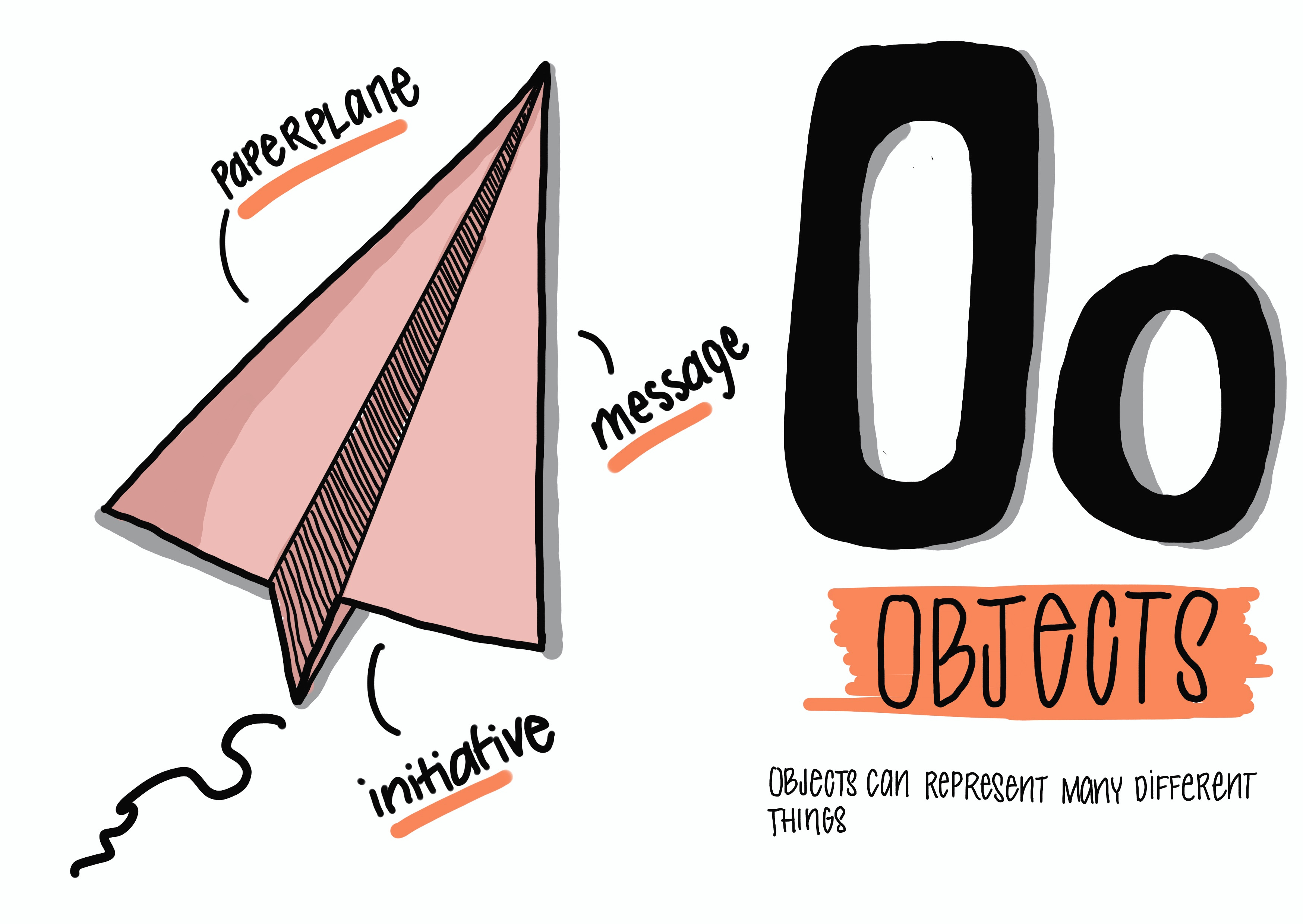
A paper plane, for instance. Draw one in a meeting, and it immediately means something is being sent. A message. A proposal going out into the world. But it also means lightness, something thrown rather than carefully delivered, something that might find its way or might not. Add a label — “new initiative” — and suddenly the shape is carrying the weight of an entire launch, and everyone in the room feels the same subtle anxiety about wind direction. (None of this requires you to be good at drawing paper planes. Mine sometimes looks more like a wedge of cheese. It still works though.)
This is what objects do that arrows and bullets cannot: they create an emotional shortcut. When you draw a boat, the room isn’t just thinking “vessel for crossing water.” It’s thinking about journeys, about being mid-crossing, about the fact that we haven’t quite reached the other shore yet. The shape brings the feeling with it, ready-assembled.
Earlier in my career, I thought visual notes were about accuracy — drawing things that looked like things. Then I sat in a session where a facilitator drew a tiny figure carrying a boulder up a hill, labelled it “compliance requirements,” and watched four directors stop talking simultaneously and start nodding at a piece of paper. The boulder was a circle. The figure had no face. It didn’t matter. The object had done something that forty minutes of careful explanations hadn’t.
You don’t need many objects to start. Six or so gets you through most conversations. Before I send you off to try it, here’s a page from my sketchbook — the ones I reach for most often, and the meanings each one can hold:
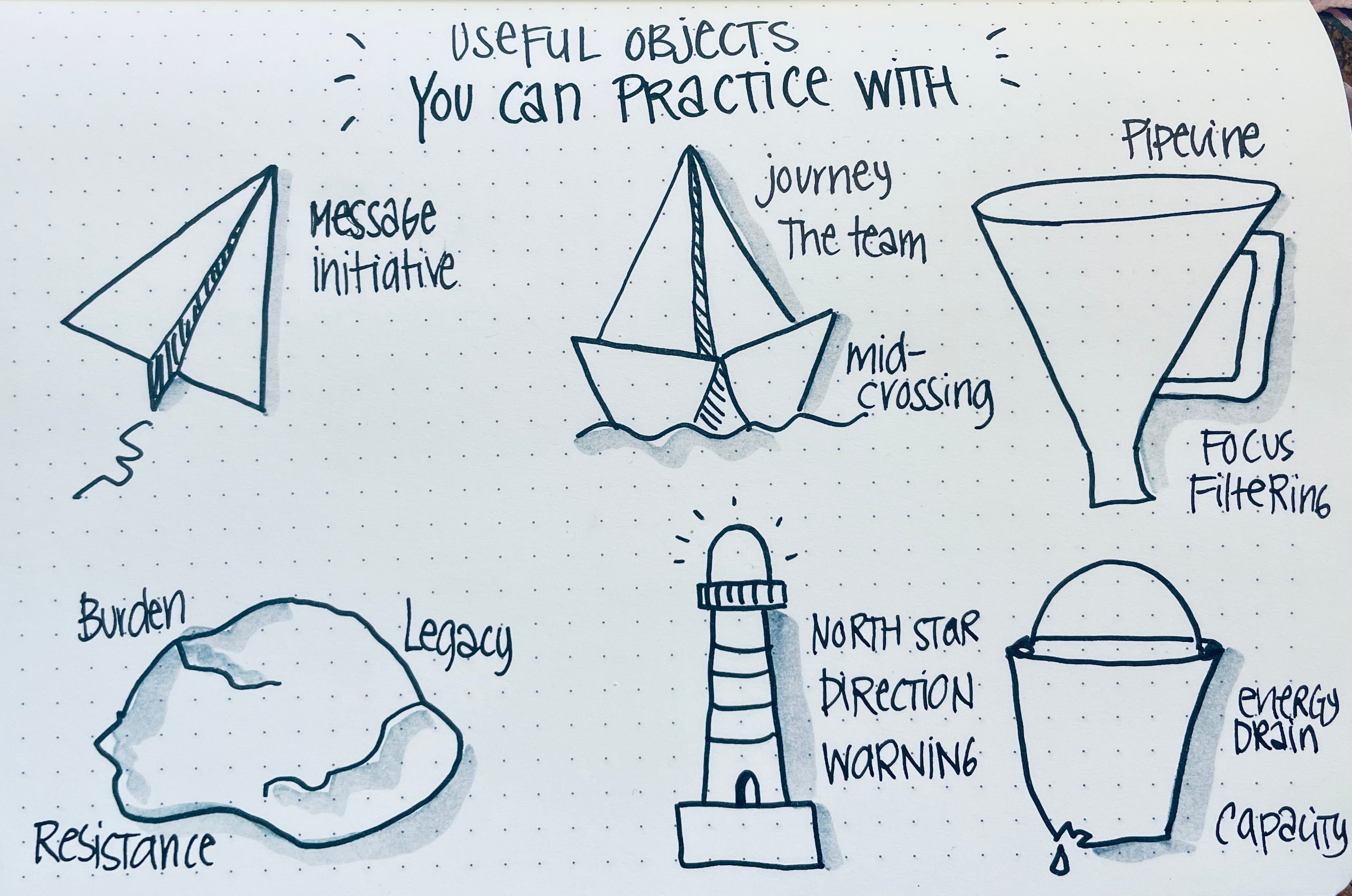
The same object shifts its meaning depending on what you label it and where you place it on the page and what conversation you are having. A lighthouse next to “our strategy” reads very differently from a lighthouse next to “what we keep saying but never do.” The drawing stays the same. The room’s understanding changes.
Try this: the next time you need to explain a complex situation — a project, a team dynamic, a strategic tangle — spend two minutes sketching it as an object before you open your mouth. Not a diagram, not a process map. An actual thing. Then ask yourself: what does this object make visible that words were obscuring?
The first thing that comes to mind is usually more honest than you think. And the added bonus is that you can use the object as a basis for your templates and summaries too.