F is for Frames
A box is never just a box

I have a soft spot for frames.
Not because they are tidy. Although they can be. And not because they make things look organised, even though that helps too.
I like them because frames change the meaning of what they hold.
Write a sentence straight onto a page and it reads like information. Put the same sentence inside a frame and suddenly it becomes something else. A quote. A headline. A provocation. A small object worth noticing.
That’s the magic of frames. They don’t just contain ideas. They give them status.
A box is never just a box.
It can turn a loose thought into a concept. It can make a messy cluster of notes feel like a finished point. It can round off a discussion without shutting it down completely. It’s a visual way of saying, “There - that is what matters. Let’s hold onto that for a moment.”
I use frames a lot in workshops for exactly this reason. When a conversation has been wandering for a while, drawing a frame around one useful sentence often brings a strange sense of relief. Not because the group is done, necessarily, but because something has landed.
(Also - let’s be honest - consultants have been charging very good money for drawing boxes around ideas for years.)
The same thing happens with speech bubbles.
A statement written plainly on a board can feel flat, even slightly bossy. Put it inside a speech bubble and it becomes a voice. A point of view. Something a user said. Something a stakeholder might say. Something the team is thinking but hasn’t quite dared to say out loud yet.
That tiny visual shift changes how people read it.
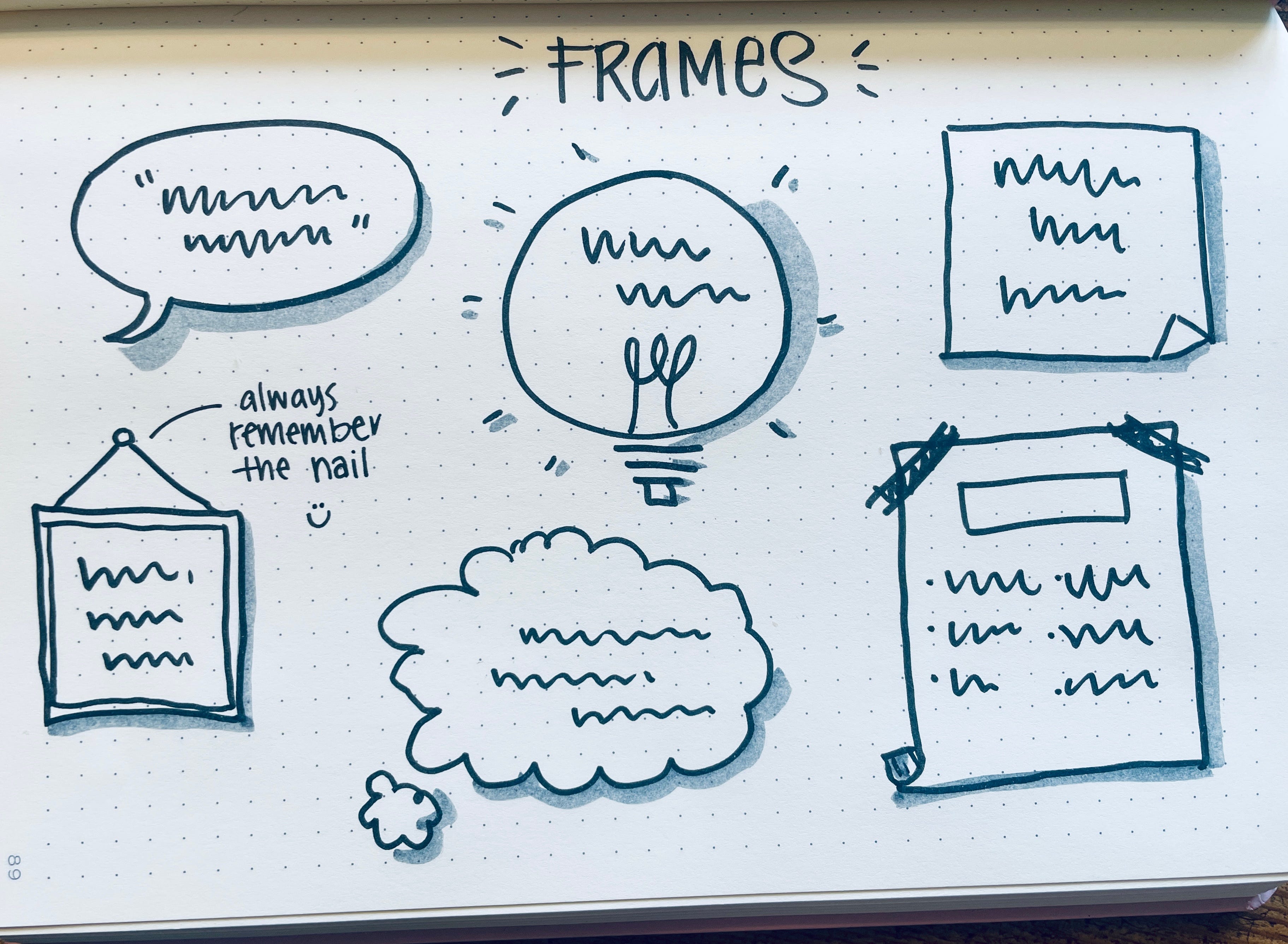
Frames are also wonderfully playful. A square frame feels different from a cloud shape. A jagged frame can make something feel tense or urgent. A heavy border makes a word feel important. A loose, hand-drawn outline makes it feel provisional, like the idea is still stretching itself awake.
And that’s where it gets fun.
Frames let you be expressive without drawing anything complicated. You can create contrast, emphasis, tone and hierarchy with one of the simplest shapes on the page.
A frame can be a sign. A label. A poster. A window. A comic panel. A painting hanging in the middle of your workshop wall. Same content, different frame, completely different feeling.
That’s why I don’t think of frames as decoration. They are part of the thinking.
They help close one part of a conversation and open the next. They help people see that an idea has taken shape. And they help visual notes feel less like a sprawl of evidence and more like something intentional.
If you want to experiment with frames this week, try this: take one sentence from your notes and draw it three different ways. Put it in a speech bubble. Put it in a bold box. Put it in a loose frame like a painting on the wall.
Then step back and notice how the meaning shifts.
Same sentence.
Different frame.
Completely different energy.
Here are some frames from my notebook to get you started: